
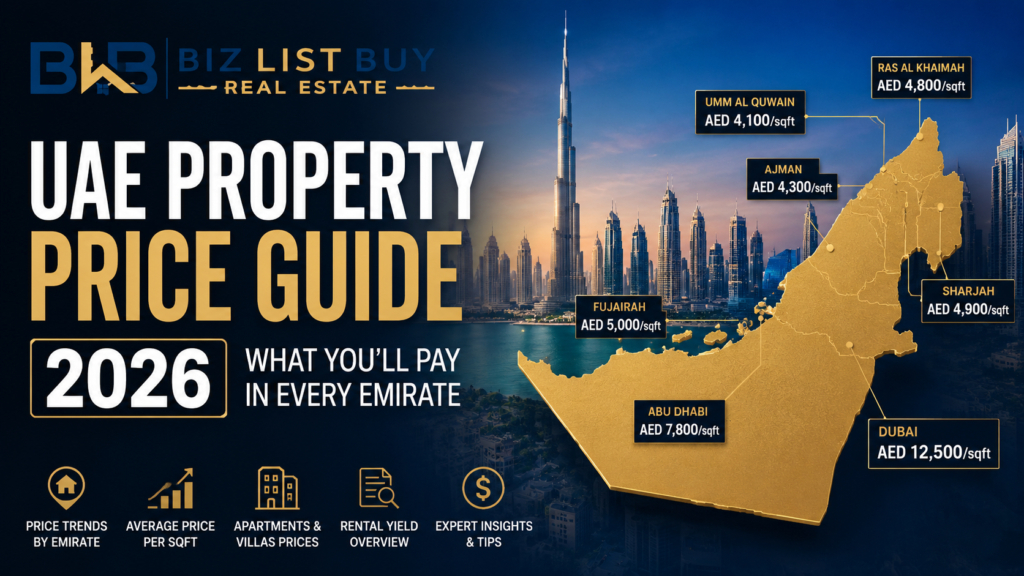
UAE Property Price Guide 2026: In 2026, UAE property prices range from roughly AED 700–850/sqft in affordable communities like International City (Dubai) to AED 3,500–4,000/sqft on Palm Jumeirah. Dubai’s citywide average sits near AED 1,916/sqft. Abu Dhabi averages AED 14,967/m² in prime downtown areas. Sharjah, Ajman, and Ras Al Khaimah offer dramatically lower entry points often 40–60% cheaper than Dubai — making the UAE a market with something for almost every budget.
If you’re thinking about buying property in the UAE, you already know the pitch: no income tax, world-class infrastructure, a booming economy, and a real estate market that has delivered serious returns over the past six years. What you might not know is exactly what you’ll pay and how dramatically that number shifts depending on which emirate, which neighbourhood, and which type of property you’re looking at.
This guide cuts through the noise. Whether you’re a first-time expat buyer eyeing a studio in Jumeirah Village Circle, a seasoned investor comparing Abu Dhabi to Dubai, or someone who has heard that Ajman is “the affordable one” and wants to know if that’s actually true you’ll find the real numbers here, updated for mid-2026.
We’ve also covered the legal basics that global buyers often get wrong: what freehold actually means, what fees hit you at closing, and what the process looks like from offer to title deed. By the end, you’ll know not just what properties cost, but what buying one will actually cost you.
How UAE Property Prices Work: The Big Picture
Before diving into emirate-by-emirate numbers, it helps to understand the structure of the UAE market. The seven emirates — Dubai, Abu Dhabi, Sharjah, Ajman, Ras Al Khaimah, Fujairah, and Umm Al Quwain — each operate their own real estate regulatory bodies, their own freehold rules, and their own pricing dynamics. They are not one market. They are seven distinct markets that happen to share a currency and a flag.
Dubai and Abu Dhabi dominate in terms of transaction volumes and international attention. The northern emirates (Sharjah, Ajman, RAK, Fujairah, Umm Al Quwain) are where affordability lives — and where a growing number of remote workers and long-term expats are looking.
One more crucial point: the UAE dirham (AED) is pegged to the US dollar at a fixed rate of approximately 3.67. This means currency risk for USD-based investors is essentially zero, which is a meaningful advantage compared to other emerging market property plays.
Dubai Property Prices 2026: What Buyers Are Actually Paying
In 2026, Dubai’s average property price is approximately AED 1,916 per square foot citywide, according to Dubai Land Department transaction data. Apartments average around AED 2,006/sqft and villas around AED 2,241/sqft. Entry-level studio apartments in outer areas start from roughly AED 350,000–650,000, while luxury properties on Palm Jumeirah begin at AED 7.5 million and rise well beyond AED 25 million.
Dubai is the headline act. It’s where international buyer interest concentrates, where the most freehold zones exist, and where pricing is most transparent thanks to the Dubai Land Department’s (DLD) publicly registered transaction data UAE Property Price Guide 2026.
Dubai Price Benchmarks by Area (2026)
Here’s what the numbers look like across key communities, based on DLD transaction data through mid-2026:
- Palm Jumeirah — AED 3,500–4,000/sqft for apartments; average villa price around AED 35 million
- Downtown Dubai / Business Bay — AED 2,200–2,800/sqft; 1-bed averages around AED 1.6M
- Dubai Marina — Average sale price approximately AED 2.6 million; AED 1,848/sqft
- Jumeirah Village Circle (JVC) — AED 1,510/sqft average; 1-bed apartments from AED 900,000
- International City — AED 700–850/sqft; one of the most affordable freehold entry points
- Discovery Gardens — AED 850–1,000/sqft
- Arabian Ranches (villas) — typically AED 3M–6M depending on size
The spread between the cheapest and most expensive micro-markets in Dubai is extraordinary. Emirates Hills — Dubai’s equivalent of Beverly Hills — trades at roughly AED 14,500/sqft, making it approximately 17 times more expensive per square foot than Discovery Gardens apartments.
Off-Plan vs. Ready: What’s the Price Difference?
Off-plan properties (units sold before completion) dominate Dubai’s new supply pipeline — accounting for around 81% of new launches. They typically offer a 15% discount versus comparable ready units, plus developer payment plans that reduce upfront cash requirements. The trade-off is delivery risk and the wait.
Ready properties cost more upfront but deliver immediate rental income and no construction risk. For first-time international buyers unfamiliar with UAE developers, ready properties in established communities often make more sense — especially if you’re buying to live rather than purely to invest.
Abu Dhabi Property Prices 2026: Stronger Growth, Fewer Options
Abu Dhabi property prices average around AED 14,967/m² in prime downtown locations, with the overall market in a stronger growth phase than Dubai in 2026. Average apartment prices run approximately AED 2,900,000 for around 1,100 sqft in popular areas like Saadiyat Island and Al Reem Island. Rental yields average around 6.08% for residential properties, with apartments reaching up to 6.50%.
Abu Dhabi has been quietly outperforming Dubai on price growth in early 2026, driven by limited supply, selective new launches, and surging international interest — particularly in lifestyle destinations like Saadiyat Island and Yas Island UAE Property Price Guide 2026.
Key Abu Dhabi Areas and Price Ranges
- Saadiyat Island — Cultural hub, premium pricing; villas AED 5.8M+ for large plots
- Yas Island — Resort-lifestyle appeal; competitive pricing relative to quality
- Al Reem Island — Established expat favourite; apartments from AED 900K–2M+
- Al Raha Beach — Waterfront living; 1-bed apartments typically AED 1.1M–1.6M
- Masdar City — Eco-friendly, tech-forward; generally more affordable
Abu Dhabi offers freehold ownership to foreigners in designated investment zones — similar to Dubai’s model. The Abu Dhabi Department of Municipalities and Transport (DMT) governs all registrations.
Northern Emirates: Where Affordability Actually Lives
Sharjah
Sharjah sits adjacent to Dubai, sharing a border — yet prices run dramatically lower. Downtown Sharjah averages around AED 8,500/m², with suburban areas at roughly AED 7,200/m². The average apartment purchase price is approximately AED 1,230,000 for around 1,100 sqft.
Foreign ownership rules in Sharjah are more restricted than Dubai — until recently, foreigners could only hold usufruct (long-term lease) rights rather than freehold title. This is changing, with new freehold zones being introduced, but it’s worth confirming current rules with a local legal advisor before committing.
Many expats live in Sharjah and commute to Dubai, attracted by rents that are 30–40% cheaper. Monthly apartment rents in areas like Al Nahda and Al Majaz range from AED 2,500–3,500.
Ajman
Ajman is the most affordable emirate for property purchases. Downtown Ajman averages just AED 3,983/m², with outer areas dropping to AED 3,013/m². Average apartment prices sit around AED 988,000 for approximately 1,200 sqft — meaning you can buy a property in Ajman for less than the DLD fee on a luxury Dubai apartment.
Foreign buyers can purchase freehold in Ajman’s designated areas. The emirate attracts value-focused investors and long-term residents priced out of Dubai and Sharjah.
Ras Al Khaimah (RAK)
RAK is the one to watch. A booming tourism and real estate sector — anchored by Wynn Resorts’ upcoming casino resort on Al Marjan Island — has put RAK on the international investment map. Downtown RAK averages AED 11,500/m², with outer areas at around AED 7,000/m². Average apartment prices are around AED 2,640,000 for approximately 940 sqft, skewed upward by premium waterfront developments.
Rental yields in RAK are lower than Dubai at around 2.72%, according to Global Property Guide’s May 2026 data — partly because prices have risen faster than rents. For capital appreciation plays, however, RAK’s trajectory is compelling.
Monthly rents in established RAK communities like Al Hamra Village and Mina Al Arab range from AED 2,200–3,200 for one-bedroom units.
Fujairah and Umm Al Quwain
Fujairah, the only emirate on the UAE’s east (Indian Ocean) coast, is quiet, scenic, and very affordable — downtown averages around AED 5,138/m². It attracts buyers in logistics, oil, and those seeking a genuinely off-the-beaten-track lifestyle.
Umm Al Quwain (UAQ) is the smallest and least densely populated emirate. Prices are among the lowest in the country, though infrastructure and amenity access are correspondingly limited.
The Real Cost of Buying Property in the UAE: Fees You Cannot Ignore
The purchase price is only the beginning. When buying property in the UAE, you need to budget an additional 6%–9% on top of the property price to cover government fees, agent commissions, and administrative costs.
Here’s what that looks like in practice:
Dubai Buying Costs (Most Detailed, as Dubai is the Primary Market for Foreign Buyers)
| Fee | Amount |
|---|---|
| Dubai Land Department (DLD) Transfer Fee | 4% of purchase price |
| DLD Admin Fee | AED 2,000–4,000 |
| Real Estate Agent Commission | ~2% of purchase price |
| Mortgage Registration Fee (if applicable) | 0.25% of loan + AED 290 |
| Property Valuation Fee (mortgage) | AED 2,500–3,500 |
| NOC Fee (resale only) | AED 500–5,000 |
| Conveyancing/Legal Fees | 0.25%–0.75% of purchase price |
Example: On a AED 2,000,000 property, expect to pay between AED 100,000–180,000 in additional costs (roughly AED 27,000–49,000 USD), depending on whether you use financing and whether you negotiate the DLD fee split with the seller.
The 4% DLD transfer fee is the biggest single cost — and it is negotiable. Some sellers agree to split it 50/50 with the buyer, particularly in a slower-moving market. For off-plan purchases, many developers waive it entirely as an incentive.
One thing the UAE market famously does not have: ongoing property taxes, capital gains taxes, or annual wealth taxes on real estate. You pay to get in, and after that, the government largely leaves you alone.
Legal Basics: What Foreign Buyers Need to Know
Freehold vs. Leasehold: In designated freehold zones, foreign buyers own the property outright — full title, no time limit. In leasehold areas, you get usage rights for up to 99 years but not perpetual ownership. Dubai has the most freehold zones of any emirate; Abu Dhabi, Sharjah, and RAK have their own designated areas.
No visa required to buy, but owning property above certain value thresholds qualifies you for UAE residency. A property worth AED 750,000 or more in Dubai can make you eligible for a 2-year investor visa; AED 2 million or more for a 10-year Golden Visa.
No local sponsor required in freehold zones. You do not need a UAE national partner to own residential property in designated areas.
The process runs roughly as follows: agree terms → sign Memorandum of Understanding (MOU) → pay deposit (typically 10%) → obtain NOC from developer (resale) → transfer at DLD/Trustee Office → receive title deed. Cash deals can complete in 2–4 weeks. Mortgage transactions typically take 6–10 weeks.
Who Should Buy Where? A Simple Framework
| Buyer Profile | Best Fit |
|---|---|
| First-time investor, budget under AED 800K | JVC (Dubai), Ajman freehold zones |
| Expat seeking rental yield + liquidity | Dubai Marina, JVC, Business Bay |
| Long-term family living, lower costs | Sharjah, RAK |
| Luxury/capital preservation | Palm Jumeirah, Downtown Dubai, Saadiyat Island |
| High-growth speculative bet | RAK (Al Marjan Island) |
| Absolute affordability, non-commuter | Fujairah, Umm Al Quwain |
What’s Driving UAE Property Prices in 2026?
Several forces are keeping the market active despite global uncertainty:
- Population growth — Dubai’s population has grown significantly, increasing housing demand structurally
- Golden Visa reforms — Long-term residency tied to property investment continues to attract international buyers
- No mortgage stress — With the AED pegged to USD, buyers face no currency risk; mortgage rates follow US Fed policy
- Supply constraints in Abu Dhabi — Limited handovers and selective launches are keeping Abu Dhabi prices firmer
- RAK tourism catalyst — The upcoming Wynn casino resort is drawing speculative and lifestyle investment to Al Marjan Island
According to Global Property Guide’s analysis from June 2026, the UAE residential market entered 2026 with strong momentum, though Q1 saw some moderation linked to regional geopolitical tensions and seasonal Ramadan/Eid slowdowns. The outlook remains broadly positive, with Abu Dhabi maintaining stronger near-term pricing momentum than Dubai.
Is Now a Good Time to Buy in the UAE?
The UAE property market in 2026 is not the same frenzied market it was in 2022–2024. It’s something arguably better for serious buyers: still growing, but with more selectivity. Dubai is moderating. Abu Dhabi is accelerating. The northern emirates are attracting a wave of lifestyle-driven buyers who have discovered that you don’t have to pay Dubai prices to live a high-quality UAE life.
The fundamentals remain strong: no property taxes, strong rental yields (6.57% average in Dubai for apartments, according to REIDIN’s April 2026 data), a currency pegged to the dollar, and a government with a proven track record of protecting investor rights in designated freehold zones.
If you’re a global buyer doing your research, you’re already ahead of the curve. The next step is getting local — talking to a RERA-registered agent, verifying your target property through the DLD’s online portal, and understanding exactly what the closing costs will be before you sign anything.
FAQs
Can foreigners buy property in the UAE?
Yes — in designated freehold zones across Dubai, Abu Dhabi, Sharjah, Ajman, RAK, Fujairah, and Umm Al Quwain. Dubai has the most extensive freehold zone network and the most transparent registration process.
What is the cheapest emirate to buy property in?
Ajman consistently offers the lowest prices, with downtown averages around AED 3,983/m². Fujairah and Umm Al Quwain are also very affordable, though with less developed infrastructure.
Do I need a UAE visa to buy property?
No. You can purchase property without being a UAE resident. However, buying above certain thresholds (AED 750K in Dubai) may qualify you for an investor residency visa.
Are there property taxes in the UAE?
There are no annual property taxes, capital gains taxes, or wealth taxes on UAE real estate. You pay the one-time 4% DLD transfer fee at purchase (in Dubai), plus agent and admin fees.
What are typical rental yields in Dubai in 2026?
According to REIDIN’s April 2026 report, apartment yields average approximately 7.08% in Dubai, with overall residential yields at 6.57%. Villas yield a lower average of around 4.54%.
Also Visit:
