
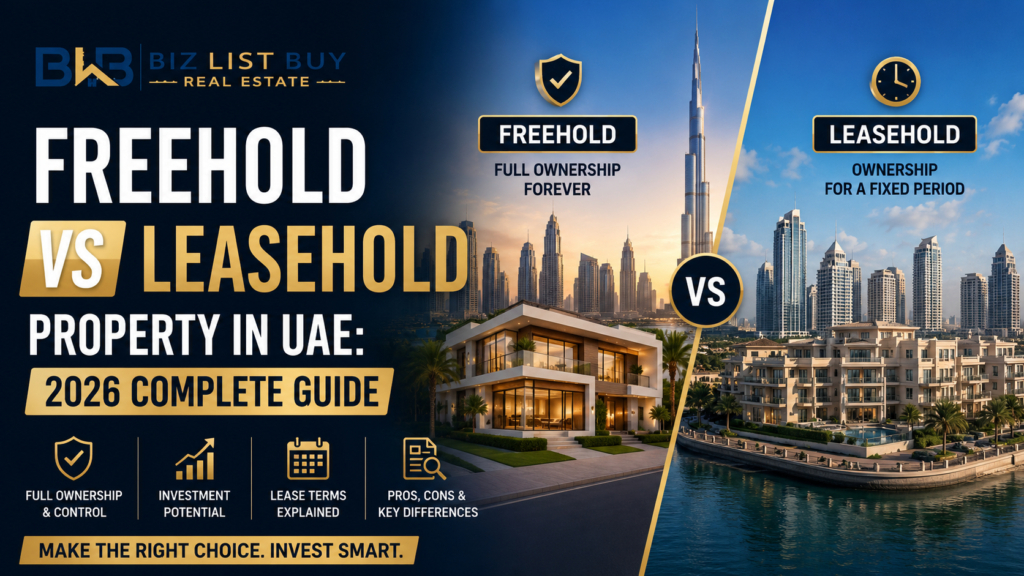
Freehold vs Leasehold Property in UAE: Buying property in the UAE is one of the most exciting — and potentially life-changing — financial decisions you can make. Whether you’re a first-time buyer, an expat looking to put down roots in Dubai, or a global investor chasing strong rental yields, understanding the legal foundation of how property ownership works here is non-negotiable.
The UAE operates two distinct systems: freehold and leasehold. Get this wrong and you could end up with a 30-year lease instead of permanent title — a detail that matters enormously when it comes to resale value, mortgage eligibility, and your long-term financial security.
This guide breaks down everything you need to know about freehold vs leasehold property in the UAE in 2026 — including the legal framework, where foreigners can buy, current price benchmarks, and which option makes more sense for your goals.
What Is Freehold Property in the UAE?
Freehold property in the UAE means you own the property and the land it sits on, permanently and outright. There’s no expiry date on your ownership. You can sell it, rent it, mortgage it, or pass it to your heirs — without restrictions.
Freehold is the gold standard of property ownership anywhere in the world, and the UAE is no exception. When you buy freehold, your name goes on the title deed registered with the relevant Land Department (such as Dubai Land Department, or DLD), and that ownership doesn’t expire.
For expatriates, the key caveat is location: foreign nationals can only purchase freehold property in areas officially designated by each emirate’s government.
Key Rights of a Freehold Owner in UAE
- Full ownership of property and land — no landlord above you
- Right to sell at any time, to anyone
- Right to lease the property and earn rental income
- Right to mortgage it with a UAE or international bank
- Right to inherit or transfer to heirs
- Potential eligibility for a UAE Golden Visa (for investments of AED 2 million+)
What Is Leasehold Property in the UAE?
Leasehold in the UAE means you buy the right to use a property for a set number of years — typically up to 99 years — without owning the underlying land. Once the lease expires, the property reverts to the landowner unless the lease is renewed.
Leasehold isn’t necessarily a bad deal — it often comes at a lower entry price point, and in some locations, the rental yields can be competitive. But there are trade-offs worth understanding clearly.
What You Should Know About Leasehold
- No land ownership — you hold a time-limited usage right
- Banks are more cautious about financing leasehold properties, especially on short remaining lease terms (under 20–30 years)
- Resale value may be lower because buyers inherit the remaining lease years
- In Sharjah, foreigners can hold usufruct rights for up to 100 years — functionally similar to leasehold
- In Abu Dhabi, foreigners can access musataha (50-year renewable) or usufruct (99-year) rights in designated investment areas
Freehold vs Leasehold — Side-by-Side Comparison
| Feature | Freehold | Leasehold |
|---|---|---|
| Own the land? | ✅ Yes | ❌ No |
| Permanent ownership? | ✅ Yes | ❌ No (up to 99 years) |
| Can you resell? | ✅ Freely | ⚠️ Yes, but buyer inherits remaining years |
| Mortgage eligibility | ✅ Easier | ⚠️ Harder (especially short leases) |
| Upfront cost | Higher | Lower |
| Resale value | Stronger | May depreciate as lease shortens |
| Available to foreigners? | In designated zones | In designated zones |
| Golden Visa eligible? | ✅ (AED 2M+) | ❌ Generally not |
UAE Property Law for Foreign Buyers: What the Law Actually Says
In Dubai, foreign ownership is permitted in areas designated as freehold. Foreigners — whether UAE residents or not — may acquire freehold ownership rights over property without restriction, usufruct rights, or leasehold rights for up to 99 years. This is governed by Article 3 of Regulation No. 3 of 2006, with title deeds issued by the Dubai Land Department.
In Abu Dhabi, the law allows expatriates to own properties in the form of floors and apartments through four main systems: long-term leasehold (99-year ownership deeds), musataha contracts (50 years, renewable), usufruct contracts (99 years of use rights), and long-term leases (minimum 25 years).
In Abu Dhabi, there are nine designated areas where foreigners are allowed to own real estate: Yas Island, Saadiyat, Reem, Mariya, Lulu, Al Raha Beach, Sayh Al Sedairah, Al Reef, and Masdar City.
In Sharjah, foreign nationals do not have the right to own property outright, but they have the right of usufruct for a maximum of 100 years after registering with the Sharjah Real Estate Registration Department — and only in areas specified by the Sharjah Government, with special approval from the Ruler.
Bottom line: Each emirate has its own rules. If you’re buying as a foreigner, always verify the zone status and ownership type before signing anything.
Best Freehold Areas in Dubai for Foreign Buyers (2026)
Dubai offers the widest and most developed freehold market for international buyers. The most sought-after zones include:
- Palm Jumeirah — Iconic waterfront living; premium pricing at AED 3,000–6,000+ per sq ft
- Downtown Dubai — Home to Burj Khalifa; 1-bed apartments averaging AED 2.3 million
- Dubai Marina — Popular with young professionals; 1-beds averaging AED 1.8 million
- Dubai Hills Estate — Family-friendly community with villa options
- Jumeirah Village Circle (JVC) — Most affordable entry point; 1-beds from around AED 900,000
- Business Bay — Emerging residential hub with strong rental demand
For buyers focused on yields over lifestyle, freehold areas such as Dubai Marina and Downtown Dubai attract significant numbers of international buyers due to the ownership benefits, while leasehold options in areas like JVC can offer lower entry prices.
UAE Property Prices in 2026: What to Expect
This is where many buyers get surprised — UAE property has moved significantly over the past few years, and 2026 is a period of moderation rather than decline.
Dubai Price Benchmarks (2026)
The typical UAE property sells for around AED 1,600 to 1,700 per square foot in early 2026, meaning a standard 1,000 sq ft apartment costs roughly AED 1.6 to 1.7 million before fees. The price gap between Dubai’s cheapest and most expensive neighborhoods is dramatic: International City averages AED 750 per sq ft while Palm Jumeirah can exceed AED 6,000 per sq ft.
A realistic entry-level budget in the UAE in 2026 is AED 650,000 to 800,000 (approximately $177,000–$218,000), which gets you an existing studio or compact one-bedroom apartment in value districts like International City.
Market Trend to Know
Price appreciation in Dubai is forecast to moderate to mid-single-digit levels of 5–8% in 2026, a marked slowdown from the 12–22% annual growth recorded during 2024–2025, as the market transitions into a more balanced phase.
According to Property Monitor’s Dynamic Price Index, Dubai residential prices rose from approximately AED 1,484 per sq ft to AED 1,676 per sq ft across 2025 — around 13% higher year-on-year.
Rental Yields — Why Investors Pay Attention
The REIDIN April 2026 report estimated residential rental yields at 6.57% in Dubai and 6.08% in Abu Dhabi, with apartment yields reaching as high as 7.08% in Dubai. These figures compare very favorably with major global cities like London (3–4%) or Singapore (2–3%).
Average gross rental yields by end of 2025 stood at approximately 7% for apartments and around 5% for villas and townhouses — positioning Dubai well within the global real estate investment landscape.
Who’s Driving UAE Property Demand in 2026?
Understanding who’s buying helps you understand where the market is heading.
Dubai’s population reached 4.03 million residents as of October 2025, growing 4.47% year-on-year — roughly 470 new residents arriving every single day.
The UAE welcomed 7,200 millionaires in the most recent year, building on influxes of 4,700 in 2023 and 5,200 in 2022, according to Henley & Partners. The total number of dollar millionaires in the UAE stood at 130,500 at end-2025, ranking it as the 14th-largest wealth market globally.
Expatriates account for over 90% of the UAE’s population, making international buyers the primary driver of real estate demand — especially in designated freehold zones.
This demographic reality is precisely why freehold zones in Dubai were created and continue to expand — the government has a strong incentive to keep international capital flowing into the property market.
The UAE Golden Visa — A Game-Changer for Property Buyers
One of the most powerful incentives for foreign buyers is the UAE Golden Visa, a long-term residency permit that ties directly to property investment.
If you purchase freehold property worth AED 2 million or more, you become eligible for a 10-year renewable residency visa. This covers you, your spouse, and your children — without requiring an employer sponsor. It’s essentially a path to long-term residency through real estate.
This has been a significant catalyst for demand at the AED 2M+ price point, particularly in communities like Downtown Dubai, Dubai Marina, and Palm Jumeirah.
Note: Leasehold purchases generally do not qualify for Golden Visa eligibility. This is one of the clearest practical advantages of choosing freehold when your budget allows.
Common Mistakes First-Time Buyers Make
1. Not Checking the Zone Designation First
Not all areas in Dubai allow foreign ownership. Always confirm the zone is officially designated as freehold before engaging an agent or signing an MOU.
2. Confusing Usufruct with Freehold
In Abu Dhabi and Sharjah, “usufruct” sounds similar to ownership — but it’s not. You get usage rights, not land title. Important distinction for resale and financing.
3. Ignoring Remaining Lease Years on Leasehold
If you’re buying leasehold with 30 years remaining, your mortgage options and resale pool narrow dramatically. Always ask how many years are left and what happens at expiry.
4. Overlooking Transaction Costs
In Dubai, budget an additional 4% DLD transfer fee plus 2% agent commission and around 0.25% mortgage registration fee (if applicable). These costs are on top of the purchase price.
5. Skipping Legal Due Diligence
Always work with a RERA-registered broker and consider hiring an independent UAE property lawyer for transactions above AED 1 million.
Freehold or Leasehold — Which Is Right for You?
Choose freehold if:
- You want permanent, unrestricted ownership
- You’re planning to stay in the UAE long-term or use the property as a primary home
- You want the option of a UAE Golden Visa
- Resale value and mortgage flexibility matter to you
Leasehold may work if:
- Your budget is tight and a freehold equivalent is out of reach
- You have a specific shorter-term plan (5–15 years)
- You’re in a market (like Sharjah) where leasehold/usufruct is the primary option available to foreigners
- The specific property and location offer compelling returns despite the ownership structure
For most international buyers entering the Dubai market in 2026, freehold remains the clear default recommendation — not just for legal security, but for financing flexibility, resale liquidity, and visa eligibility.
Final Checklist Before You Buy Property in UAE
✅ Confirm the zone is designated freehold for foreign ownership
✅ Verify the developer or seller holds a valid UAE license
✅ Use a RERA-registered broker in Dubai (search via Dubai REST app)
✅ Budget for DLD fees (4%), agent fees (2%), and mortgage costs
✅ Get an independent legal review for properties above AED 1M
✅ Check whether the purchase qualifies for UAE Golden Visa
✅ Understand the service charge structure and annual maintenance fees
Ready to Explore UAE Property Listings and Investment Opportunities?
Whether you’re comparing freehold apartments in Dubai Marina, researching off-plan options in Abu Dhabi, or simply learning the landscape before committing — the right information makes all the difference.
Explore more expert guides and property insights on the BizListBuy Blog, where we break down global real estate markets, business opportunities, and investment strategies for buyers at every level.
Ready to take the next step? Visit BizListBuy to browse listings, connect with verified professionals, and make your UAE property journey a confident one.
FAQs
Q1. What is the main difference between freehold and leasehold property in UAE?
Freehold gives you permanent, full ownership of both the property and the land it sits on — with no expiry date. Leasehold gives you the right to use a property for a fixed period (typically up to 99 years) without owning the land. When the lease ends, ownership reverts to the landowner unless renewed. For most foreign buyers in Dubai, freehold is the stronger and more secure option.
Q2. Can foreigners buy freehold property anywhere in Dubai?
No — not anywhere. Foreign nationals can only purchase freehold property in officially designated freehold zones. Popular examples include Palm Jumeirah, Downtown Dubai, Dubai Marina, Dubai Hills Estate, Business Bay, and Jumeirah Village Circle (JVC). Outside these zones, non-UAE nationals are generally not permitted to hold freehold title.
Q3. What is a usufruct property in UAE, and how is it different from freehold?
A usufruct gives you the right to use and benefit from a property — including renting it out — for a defined period (up to 99 years in Abu Dhabi and 100 years in Sharjah), but you do not own the land or hold permanent title. Unlike freehold, usufruct rights expire and cannot be inherited indefinitely. It is the primary ownership structure available to foreigners in Abu Dhabi and Sharjah.
Q4. Does buying property in UAE qualify me for a Golden Visa?
Yes — if you purchase freehold property valued at AED 2 million or more, you become eligible for the UAE 10-year Golden Visa. This covers you, your spouse, and your children, and does not require an employer sponsor. Leasehold purchases generally do not qualify. The Golden Visa is one of the strongest arguments for targeting freehold properties at the AED 2M+ price point.
Q5. What are the total costs involved in buying property in Dubai?
Beyond the purchase price, buyers should budget for the following:
- 4% Dubai Land Department (DLD) transfer fee
- 2% real estate agent commission
- 0.25% mortgage registration fee (if financing)
- AED 4,000–5,000 in DLD admin and title deed fees
- Optional: independent legal fees (recommended for transactions above AED 1 million)
In total, expect to add roughly 6–7% on top of your agreed purchase price.
Q6. Is leasehold property a bad investment in Dubai?
Not necessarily — but it depends on your goals. Leasehold can offer a lower entry price and competitive yields in certain locations. The risks are that mortgage financing becomes harder as the lease shortens, resale value may decline over time, and Golden Visa eligibility is typically off the table. For long-term investors or homeowners, freehold offers greater security and liquidity. Leasehold makes more sense for shorter-term plans or budget-constrained buyers.
Q7. What are the best freehold areas to buy property in Dubai in 2026?
The most popular freehold zones for foreign buyers in 2026 include:
- Palm Jumeirah — Ultra-premium waterfront; AED 3,000–6,000+ per sq ft
- Downtown Dubai — Iconic city-centre living; 1-beds from AED 2.3M
- Dubai Marina — Vibrant lifestyle hub; 1-beds averaging AED 1.8M
- Business Bay — Growing residential and business district
- JVC (Jumeirah Village Circle) — Most affordable freehold entry; 1-beds from ~AED 900K
- Dubai Hills Estate — Family-friendly villas and apartments
Q8. How much does property cost in Abu Dhabi for foreign buyers in 2026?
Abu Dhabi’s market is experiencing strong momentum. Residential sale prices rose approximately 30% year-on-year by late 2025, with rental yields averaging 6.08% for residential properties (up to 6.50% for apartments). Foreigners can buy in nine designated investment zones — including Yas Island, Saadiyat Island, and Reem Island — under usufruct or musataha structures rather than outright freehold.
Q9. Can I get a mortgage in UAE as a foreigner to buy property?
Yes, most major UAE banks offer mortgages to foreign nationals, subject to eligibility criteria. As a non-resident expat, you can typically borrow up to 75% of the property value (75% LTV) for your first property. Freehold properties are significantly easier to finance than leasehold, particularly if the remaining lease is under 25–30 years. Interest rates in the UAE track the US Federal Reserve, and conditions improved heading into 2026 as rates began to ease.
Q10. What happens to my leasehold property when the lease expires in UAE?
When a leasehold period ends, the property legally reverts to the landowner (the freeholder) unless a renewal agreement is reached. In some cases — particularly for usufruct arrangements under Abu Dhabi law — holders with leases of more than 10 years may have rights to mortgage or transfer the property without the landowner’s consent. However, this varies by emirate and contract terms. Always seek legal advice on what happens at lease end before committing to a leasehold purchase.
Also Visit:
